Jump Rope Calorie Calculator: How Many Calories You’re Really Burning
A jump rope calorie calculator estimates your burn by combining body weight, jump pace, and workout time into a simple MET-based formula, so you can get a solid number without any extra gear. If you’ve finished a session soaked in sweat and wondered exactly how many calories you burned, this is the same math any jump rope calculator or fitness app runs behind the scenes. In 2026, jump rope remains one of the cheapest, most portable pieces of cardio equipment you can own, which makes understanding the formula worth five minutes of your time. Below, we break down the MET calculation step by step and rank the ropes that make it easiest to sustain the pace that actually drives calorie burn.
The best jump ropes for calorie-burning cardio workouts

WOD Nation Speed Rope
The ball-bearing swivel handles are built to keep this rope spinning smoothly even at sprint-interval pace, which matters if you're trying to hit a high MET output for calorie burn. Owners note it's light enough that forearm fatigue doesn't slow the rope down before your legs give out.
- Smooth ball-bearing rotation
- Easy cable length adjustment
- Great for double-under practice
- Thin cable can kink if stored coiled tightly
- Handles feel small for larger hands

Crossrope Get Lean Weighted Rope System
Swapping between the lighter and heavier rope segments lets you raise perceived effort without changing your jump cadence, which is one of the fastest ways to push a jump rope session into a higher-calorie-burn zone. The companion app also logs sessions if you want a running total instead of doing math after every workout.
- Interchangeable weighted ropes
- App tracks reps and estimated calories
- Comfortable, grippy handles
- Priced well above a basic rope
- App account required for full tracking features

RPM Speed Ropes Elite
Owners reach for this rope during timed AMRAP-style sessions because the cable barely flexes, so timing double-unders stays consistent even as heart rate climbs and calorie burn ramps up. The handles run a bit longer than most, which reviewers describe as either a plus or something that takes some getting used to.
- Extremely durable coated cable
- Consistent spin at high speed
- Multiple cable weights available
- Longer handles aren't for everyone
- No beginner-friendly cushioned cable option
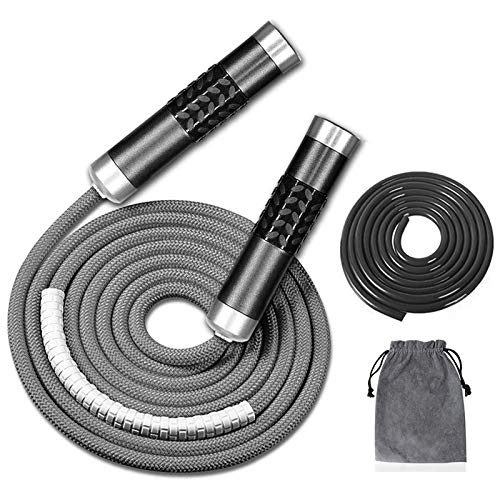
Everlast Weighted Jump Rope
At this price point, this rope's spec sheet and owner reports point to solid durability through months of moderate-pace sessions, and the slight weight in the cable makes steady-pace jumping feel like more work per minute than a plain licorice-style rope. It's not built for speed drills, but for general fat-burning cardio it gets the job done.
- Affordable entry point
- Slight added weight increases effort
- Comfortable foam-covered handles
- Cable isn't ideal for fast double-unders
- Swivel wears faster than premium ropes

Trideer Adjustable Jump Rope
The tangle-resistant cable and easy length adjustment make this a low-frustration option for anyone who hasn't jumped rope regularly since childhood, according to owner feedback. It won't hit elite speed, but it's reported to keep newer jumpers going longer without stopping to fix a tangled cable, which matters more for total calories burned than raw speed.
- Simple length adjustment
- Tangle-resistant cable
- Very affordable
- Not built for advanced speed training
- Handles are basic plastic

Sportneer Digital Jump Rope with Counter
The built-in digital counter displays jump count, time, and an estimated calorie burn right on the handle, which owners say is handy when they don't want to pull out a phone mid-set. The estimate relies on generic assumptions, so it's worth cross-checking against the MET-based formula below.
- Built-in digital display
- No app or phone needed mid-workout
- Good value for the added tech
- Calorie estimate is generic, not personalized
- Slightly heavier handles than non-digital ropes
How a jump rope calorie calculator actually works
Whether you use a free tool inside a fitness app or any other calorie calculator for jump rope, they all rely on one central concept: MET, short for Metabolic Equivalent of Task. This value tells you how many times more energy an activity uses than sitting at rest. For jump rope, the MET value shifts with your pace, sitting at roughly 8.8 when you jump slowly and casually and climbing to 12.3 or more when you jump fast and hard with few breaks. The formula behind it is straightforward.
Calories burned = MET x body weight in kilograms x time in hours
So a 165-pound person (about 75 kg) jumping at a moderate MET of 11.8 for 20 minutes (0.33 hours) would estimate roughly 11.8 x 75 x 0.33 = about 292 calories. Drop the pace to a slower MET of 8.8 for the same 20 minutes and that estimate falls to roughly 218 calories. The gap between those two numbers is exactly why the rope you use, and how consistently it lets you hold a fast pace, matters as much as the raw time on the clock.
Why your rope choice changes the math
A calculator can only estimate based on the pace and time you actually sustain. Owners consistently report that cheap tangle-prone ropes and stiff, poorly balanced cables are a common reason sessions stall out at a slower MET range, since jumpers keep stopping to untangle or reset the cable. A smooth-spinning, properly weighted rope tends to keep people jumping longer at a faster, more consistent cadence, which is what pushes the calorie estimate toward the higher end of the range rather than the lower end.
| Pace | Approx. MET | 150 lb / 20 min | 180 lb / 20 min | 200 lb / 20 min |
|---|---|---|---|---|
| Slow, casual | 8.8 | ~200 cal | ~240 cal | ~267 cal |
| Moderate, steady | 11.8 | ~268 cal | ~322 cal | ~358 cal |
| Fast, vigorous | 12.3 | ~280 cal | ~336 cal | ~373 cal |
These numbers come from standard MET tables and are estimates, not a personal metabolic measurement, so they should be seen as a rough guide rather than an exact figure. What you actually burn will vary depending on your fitness level, how efficient your technique is, how much you rest between sets, and even the type of rope you're using.
How we chose the ropes on this list
This ranking weighs cable durability as reported by long-term owners, how easy each rope is to adjust to the right length per the listing specs, how smoothly the handles are designed to spin at both moderate and sprint paces, and how well each rope resists tangling or kinking during storage based on owner feedback. We also weighed value, since a jump rope is one of the few pieces of cardio equipment where spending more doesn’t automatically buy a better workout.
Weighted ropes vs. Speed ropes for calorie burn
Weighted ropes, like the Crossrope system or the Everlast option above, add resistance to every rotation, which raises the effort of even a moderate-pace session. Speed ropes, like the WOD Nation or RPM Elite, are built to be as light and fast as possible, rewarding technique and cadence over brute resistance. For most people chasing a specific calorie target, a speed rope that lets you sustain a faster, uninterrupted pace will outperform a weighted rope swung at a slower, choppier pace, even though the weighted rope feels harder rep for rep.
Interval work moves the needle more than steady pacing
Because MET values jump meaningfully between “moderate” and “vigorous” pace, interval-style jump rope work, such as 30 seconds fast followed by 30 seconds recovery, tends to produce a higher average calorie burn over a session than jumping at one steady, sustainable pace the whole time. If you’re using a calorie calculator to plan a workout, building in short bursts of true max-effort jumping is one of the simplest ways to push your estimate higher without extending total workout time.
Getting a more accurate personal estimate
If you want a number that’s closer to your actual physiology rather than a generic MET table, a fitness tracker or heart rate monitor that accounts for your age, weight, and real-time heart rate will generally out-perform a static jump rope calorie calculator. Still, for planning workouts or comparing effort levels across sessions, the MET-based math above is a reliable, free way to estimate your burn without any extra gear.
Related guides
- More buying guides
- Best cardio accessories
- Home gym equipment essentials
- Resistance training gear
- Recovery tools for after cardio
- How we rank equipment
- About TalkGyms
Ready to start tracking your calorie burn?
Grab one of our tested jump ropes and put the MET formula to work in your next session.
Frequently asked questions
Is a jump rope calorie calculator accurate?
It gives a reasonable estimate based on standard MET values, body weight, and time, but it isn’t personalized to your metabolism the way a heart rate-based tracker can be. Treat it as a solid ballpark rather than an exact figure.
Does a weighted jump rope burn more calories than a regular rope?
Often yes, rep for rep, because the added resistance increases effort. But a lighter speed rope that lets you sustain a faster, uninterrupted pace can produce a similar or higher overall calorie burn over a full session.
How many calories does 20 minutes of jump rope burn?
Using standard MET values, a 150-pound person burns roughly 200 to 280 calories in 20 minutes depending on pace, while a 200-pound person burns roughly 267 to 373 calories in the same time.
Do double-unders burn more calories than single jumps?
Generally yes, since double-unders require more power output per rotation and tend to elevate heart rate faster, which pushes your effective MET value higher.
What jump rope length should I use?
A common guideline is that when you stand on the center of the rope, the handles should reach roughly to your armpits. Most adjustable ropes make it easy to fine-tune this to your height.
Can beginners get an accurate calorie estimate too?
Yes, but beginners often jump at a slower, more interrupted pace due to tangles or missed reps, which naturally lowers the MET value used in the calculation until technique improves.
Is jumping rope better than running for burning calories?
Per minute, vigorous jump rope intervals can burn calories at a comparable or higher rate than moderate running, largely because it’s easy to sustain a high-intensity pace in short bursts.
How do I increase the accuracy of my calorie estimate?
Track your actual time spent jumping at a specific pace rather than total workout time including rest, and if possible pair the MET formula with a heart rate monitor for a more personalized number.
More Buying Guides
 Jump Rope Cardio Workout: The Ropes and Routines That Actually Deliver ResultsWhat Does a Mini Barbell Do? A Real-World Breakdown for Home Gyms
 Forearm Workouts With Dumbbells: The Best Sets for Grip and Wrist StrengthThe Real Benefits of a Rowing Machine (And Who It’s Actually Best For)Barbell vs. Dumbbell: Which One Should Anchor Your Home Gym?Why Are Dumbbells So Expensive? What Actually Drives the Price in 2026