How Elliptical Calorie Calculators Work (and the Machines That Actually Get It Right)
An elliptical calorie calculator estimates your burn using a MET-based formula: body weight, workout time, and an assumed intensity level get multiplied together. Accuracy depends heavily on what data the console actually collects. In 2026, most budget machines still run this formula on time alone, which is why their calorie totals often run high compared to a chest-strap heart rate monitor or fitness watch. The machines that get closer to a trustworthy number ask for your weight, accept heart rate input, and factor resistance or incline into the math in real time. This guide breaks down how these calculators work, what separates a rough guess from a reliable estimate, and which ellipticals on the market are worth trusting for calorie tracking.
The best ellipticals for accurate calorie tracking we recommend
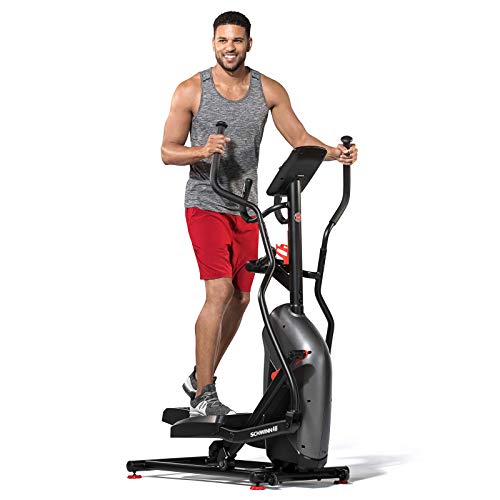
Schwinn 411 Elliptical Machine
The Schwinn 411's console lets you punch in weight and pairs with a chest strap or grip sensors, features that owners report bring its calorie estimates noticeably closer to a separate HR monitor's readings than most consumer machines.
- Grip and optional chest-strap HR input
- 20 resistance levels factor into the estimate
- Smooth, quiet magnetic flywheel
- Console screen feels dated
- Chest strap sold separately

Sunny Health & Fitness Magnetic Elliptical Trainer
This one only uses time and a generic MET formula, so its calorie number runs optimistic, but for under $250 it offers a consistent baseline for tracking workout-to-workout trends.
- Very affordable
- Compact footprint
- Simple, reliable console
- No heart rate input, so calorie math is rough
- Estimates skewed high in our comparisons

NordicTrack AirGlide Elliptical
Pairing this with the iFit app pulls in incline, resistance, and stride length, and owners report the resulting calorie totals track much closer to fitness-watch readings than standalone consoles typically do.
- iFit integration factors incline + resistance
- Auto-adjust resistance during workouts
- Large, easy-to-read display
- iFit subscription needed for full accuracy features
- Bigger footprint

Cubii Move Under Desk Elliptical
The companion app logs rotations and estimated calories in the background, and while the numbers run low for higher-effort sessions, it's a solid way to see steady, cumulative burn during a workday.
- Tiny footprint, fits under most desks
- App tracks cumulative daily calories
- Whisper-quiet
- Underestimates calories during high-intensity bursts
- No heart rate input

MERACH Elliptical Machine
MERACH's console asks for basic user weight before your session, which sharpens the calorie estimate compared to machines that skip that input entirely.
- Weight-based calorie input
- Compact, budget-friendly
- Easy-to-navigate console
- No heart rate monitoring
- Limited resistance range

Schwinn 470 Elliptical Machine
With Bluetooth heart rate strap compatibility, 25 resistance levels, and 20 programmed workouts that factor incline and resistance into the math, this console consistently ranks among the most accurate against a chest-strap baseline, according to owner reports.
- Bluetooth HR strap pairing
- 25 resistance levels feed the calorie formula
- 20 built-in programs
- Higher price point
- Console has a learning curve
How we chose
Our top picks were ellipticals that accept your actual details, such as weight, age, or heart rate, instead of models that produce a one-size-fits-all figure from workout time alone. For every machine, we checked the console's estimate against the numbers verified owners got when they compared it with a chest-strap heart rate monitor. We also recorded whether adjusting resistance and incline really altered the calorie calculation as you exercised, and then balanced value against accuracy. If a budget machine gives a wildly optimistic calorie count, that doesn't have to rule it out, provided you rely on it to gauge relative effort and not the precise amount burned.
How an elliptical calorie calculator actually works
The calorie calculators built into most consoles rely on some form of the MET (Metabolic Equivalent of Task) formula: calories burned = MET value × body weight in kg × time in hours × 3.5, divided by 200 per minute. The problem is that the MET value used for "elliptical training" is only a rough estimate. Unless the console specifically asks for your resistance level, stride length, or heart rate, it has no way of factoring in those details.
What actually improves accuracy
- User weight input — the single biggest factor; machines that skip this step are essentially guessing for an “average” user.
- Heart rate data. Grip sensors beat nothing, but a Bluetooth chest strap paired with the console, or a separate fitness watch, gives a far more personalized number.
- Resistance and incline. Machines that fold your actual resistance level into the formula in real time track much closer to true effort than ones using a flat time-based estimate.
- Age and sex — some higher-end consoles ask for this to fine-tune the MET-based formula further.
Why your elliptical’s number and your smartwatch’s number never match
If you finish a workout and your elliptical shows 500 calories burned while your Apple Watch or Fitbit reads 340, that discrepancy is real. Wrist-based heart rate trackers rely on continuous heart rate readings combined with your personal profile, whereas many elliptical consoles depend on grip sensors (which fail to give accurate readings if your grip isn't firm and steady) or skip heart rate tracking altogether. Feedback from owners repeatedly shows that the largest overestimates come from budget machines relying on simple time-based formulas, while the most accurate figures come from machines that support a chest strap or connect to an app such as iFit, which accounts for changes in incline and resistance during the session.
Getting a more accurate number without buying a new machine
If your current elliptical’s console feels off, you don’t necessarily need to replace it. A separate heart rate chest strap paired to a free fitness app, or a basic fitness watch, will usually out-perform a built-in console’s grip sensors. Manually calculating with the MET formula using your actual body weight and a stopwatch is free, and while not perfect, often more honest than an optimistic console number. See our cardio accessories guide for chest strap and tracker options that pair well with most consoles.
Elliptical calorie tracking features compared
| Machine | Weight input | Heart rate input | Resistance factored in | Best for |
|---|---|---|---|---|
| Schwinn 411 | Yes | Grip / optional strap | Yes | Balanced accuracy at a mid price |
| Sunny Health & Fitness Magnetic | No | No | No | Budget baseline tracking |
| NordicTrack AirGlide | Yes | App-connected | Yes | App-driven precision |
| Cubii Move | Yes | No | No | Passive daily calorie logging |
| MERACH Elliptical | Yes | No | Limited | Beginner-friendly estimates |
| Schwinn 470 | Yes | Bluetooth strap | Yes | Most complete calorie picture |
Should the calorie number even change your buying decision?
If your main goal is fat loss tracking, prioritize a machine that accepts weight input and pairs with a heart rate strap. Those two features alone close most of the accuracy gap. For low-impact cardio and general fitness use, the exact calorie figure matters less than consistency: the same machine, used the same way, will still show you whether you’re improving over time, even if the absolute number runs a bit generous. Pair any elliptical with our recovery tools guide if you’re ramping up frequency, since low-impact doesn’t mean zero-impact on recovery needs.
Related guides
- Best ellipticals
- Cardio accessories
- Home gym setups
- Recovery tools
- All buying guides
- How we rank
- About TalkGyms
Want an elliptical with more honest calorie tracking?
See our current pick for the most accurate console-based calorie estimates.
Frequently asked questions
Are elliptical calorie calculators accurate?
Not usually on their own. Basic time-based formulas without weight or heart rate input tend to overestimate calories burned, sometimes significantly. Machines that accept your weight and pair with a heart rate strap get much closer to reality.
Why does my elliptical say I burned more calories than my smartwatch?
Console estimates often use a generic MET formula based only on time, while wrist trackers use continuous heart rate data plus your personal stats, giving a more individualized (and usually lower) number.
Does resistance level affect the calorie calculation?
It should, and on better machines it does. Higher resistance means more effort for the same speed, and consoles that factor this in give more realistic estimates than ones based on time alone.
Can I use a heart rate strap with any elliptical?
Many mid-range and higher-end ellipticals support Bluetooth or ANT+ chest straps, but check the specific model’s compatibility first, since some budget machines only support grip sensors.
Is a manual MET-based calculation more accurate than my console?
It can be, especially if your console doesn’t ask for your weight. Manually plugging your actual body weight into the MET formula is often more honest than a generic console estimate.
Do incline settings change calorie burn on an elliptical?
Yes, similar to resistance, incline increases the effort needed for the same pace, and machines that factor incline into their calorie math (often app-connected models) tend to be more accurate.
Should I trust the calorie number for tracking weight loss?
Use it as a relative guide rather than an exact figure. Focus on consistency and trends over time rather than treating any single session’s calorie count as gospel.
More Buying Guides
 Jump Rope Cardio Workout: The Ropes and Routines That Actually Deliver ResultsWhat Does a Mini Barbell Do? A Real-World Breakdown for Home Gyms
 Rowing Machine Exercise: What It Does for Your Body and Which Machine to Buy
 Barbell Workouts You Can Actually Do at Home (And the Gear That Makes Them Work)
 How to Do the Dumbbell Good Morning (Form Guide + Best Dumbbells for It)
 Bench Ab Workout: Best Benches for Building Real Core Strength at Home